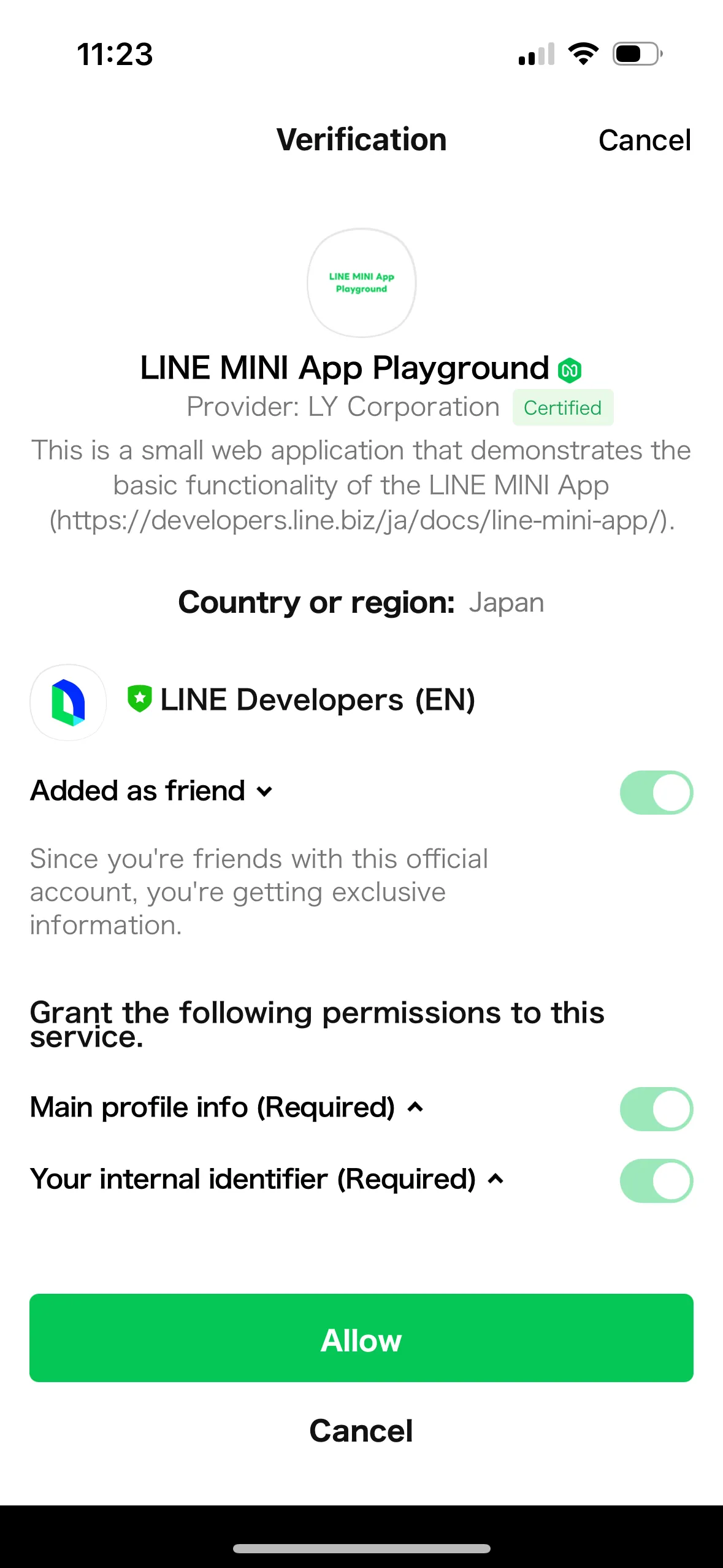

LINE MINI App authorization flow
For a LIFF app to get user information or send messages to users, users need to consent to the corresponding permissions on the channel consent screen when they access the LIFF app for the first time.
In LINE MINI Apps, enabling the "Channel consent simplification" feature makes it easier for users to access the LINE MINI App.
This page explains the "Channel consent simplification" feature and the authorization flow based on it.
- What is the "Channel consent simplification" feature
- Authorization flow in LINE MINI Apps where the "Channel consent simplification" feature is enabled
- Authorization flow in LINE MINI Apps where the "Channel consent simplification" feature is disabled
What is the "Channel consent simplification" feature
The "Channel consent simplification" feature is a mechanism that simplifies the permission consent required when users access a LINE MINI App for the first time.
Enabling the "Channel consent simplification" feature allows users to skip the channel consent screen when they access a LINE MINI App for the first time and start using the LINE MINI App immediately. To improve the user experience, we recommend enabling the "Channel consent simplification" feature.
The "Channel consent simplification" feature applies only to the permission to get the user ID (the openid scope). Permissions required to get user profile information or send messages (such as the profile scope and the chat_message.write scope) aren't included in the feature. For these additional permissions, the verification screen is displayed within each LINE MINI App at the time the permissions are needed. For more information, see Request permissions other than the openid scope on the verification screen.
For new LINE MINI App channels in Japan, the "Channel consent simplification" feature is always enabled. For more information, see the news from January 8, 2026.
If your LINE MINI App is designed to call the LINE Login API using an access token or an ID token retrieved via the LIFF SDK, the "Channel consent simplification" feature may cause your LINE MINI App to behave differently than expected.
For example, if your LINE MINI App is designed to call the Verify ID token endpoint and use the retrieved user profile information to create a service account for your LINE MINI App, the ID token payload won't include the user's profile information because the "Channel consent simplification" feature skips consent for retrieving the user's profile information (the profile scope). As a result, you can't use the user's profile information to create a service account.
To avoid this issue, before getting an access token or an ID token, display the verification screen using the liff.permission.query() method and the liff.permission.requestAll() method, and request the required permissions from the user. For more information, see Request permissions other than the openid scope on the verification screen.
The "Channel consent simplification" feature setup
The "Channel consent simplification" feature can be configured only if all of the following conditions are met:
- Region to provide the service is set to "Japan" in the LINE MINI App channel.
- The status of the LINE MINI App channel is "Not yet reviewed".
For LINE MINI App channels created before January 8, 2026, to enable the "Channel consent simplification" feature, turn on the toggle in the Channel consent simplification section on the Web app settings tab of the LINE MINI App channel in the LINE Developers Console.
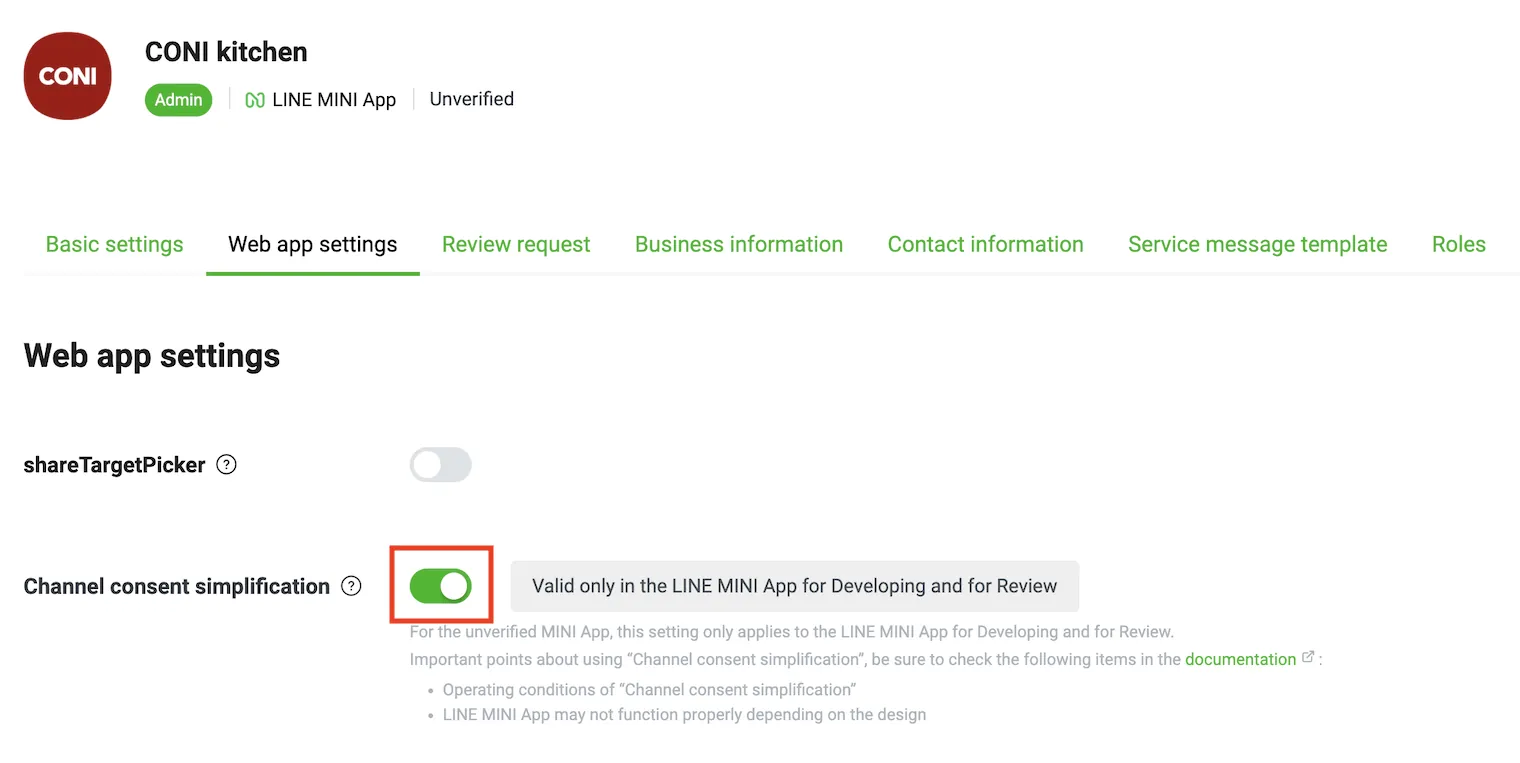
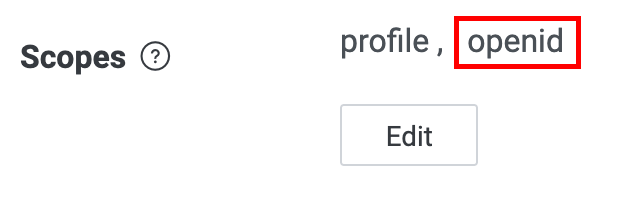
Note that because the "Channel consent simplification" feature simplifies consent for getting the user ID (the openid scope), enabling it also automatically enables openid in the Scope section.
For LINE MINI App channels created on or after January 8, 2026, the "Channel consent simplification" feature is always enabled. No configuration is required in the LINE Developers Console.
Operating conditions for the "Channel consent simplification" feature
For the "Channel consent simplification" feature to work, all of the following conditions must be met:
- LINE MINI App is a verified MINI App (*).
- The LIFF SDK version of the LINE MINI App is v2.13.x or later.
* For unverified MINI Apps, this feature works only in the LINE MINI App for Developing and for Review.
Conditions for the "Channel consent simplification" feature to work in LIFF-to-LIFF transitions
When you open a LINE MINI App that meets the operating conditions for the "Channel consent simplification" feature above via a LIFF-to-LIFF transition, the feature works if the destination URL is a LIFF URL. However, if the destination URL is an endpoint URL, the feature doesn't work.
Authorization flow in LINE MINI Apps where the "Channel consent simplification" feature is enabled
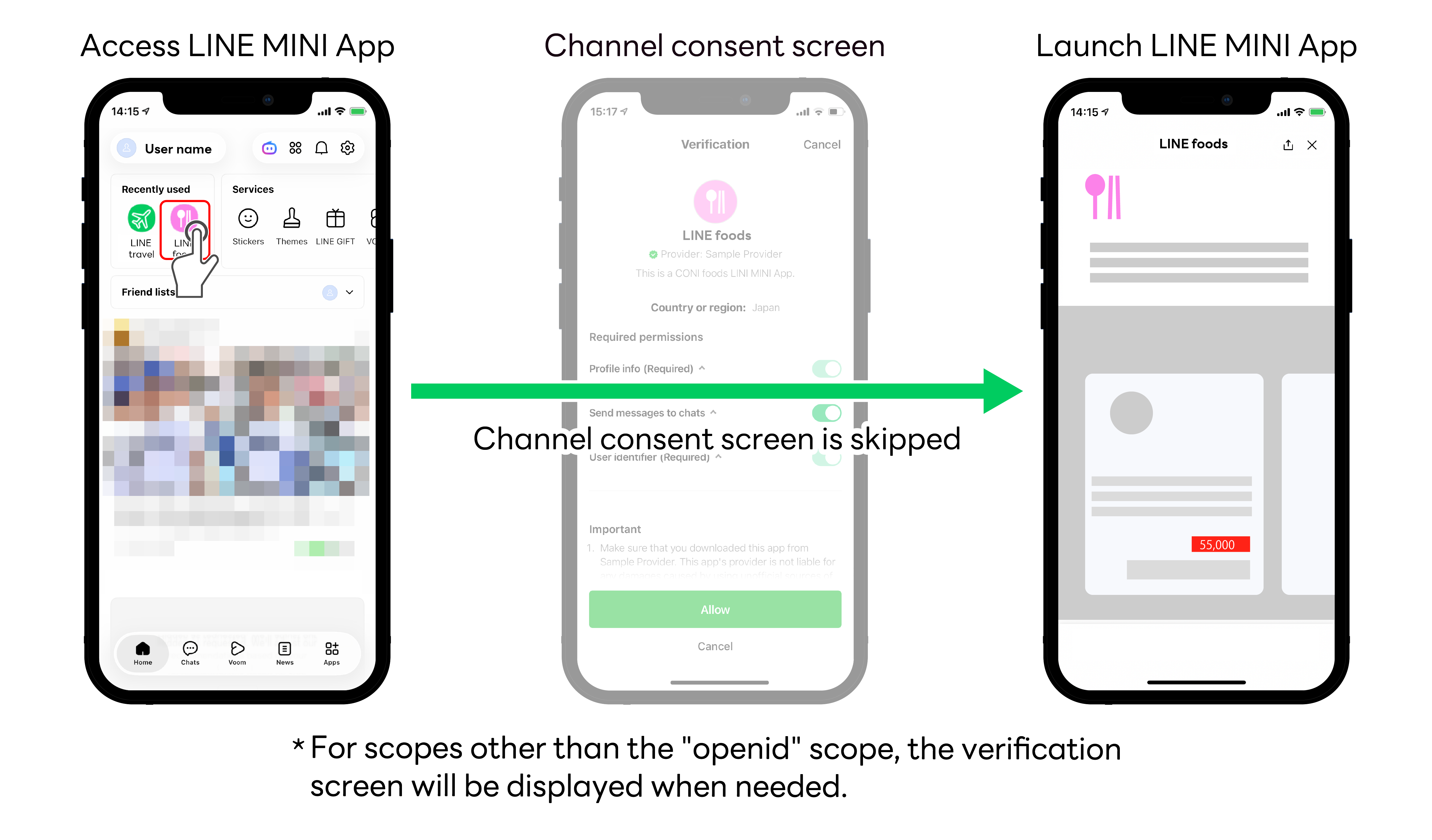
In LINE MINI Apps where the "Channel consent simplification" feature is enabled, the LINE MINI App opens with permission to get the user ID (the openid scope) granted.
If additional permissions are required, see Request permissions other than the openid scope on the verification screen.
Request permissions other than the openid scope on the verification screen
When you execute methods that require permissions other than the openid scope, such as the liff.getProfile() method or the liff.sendMessages() method, the verification screen is displayed. On the verification screen, the additional permissions requested by the LINE MINI App are shown, and users are asked whether they want to grant those permissions.
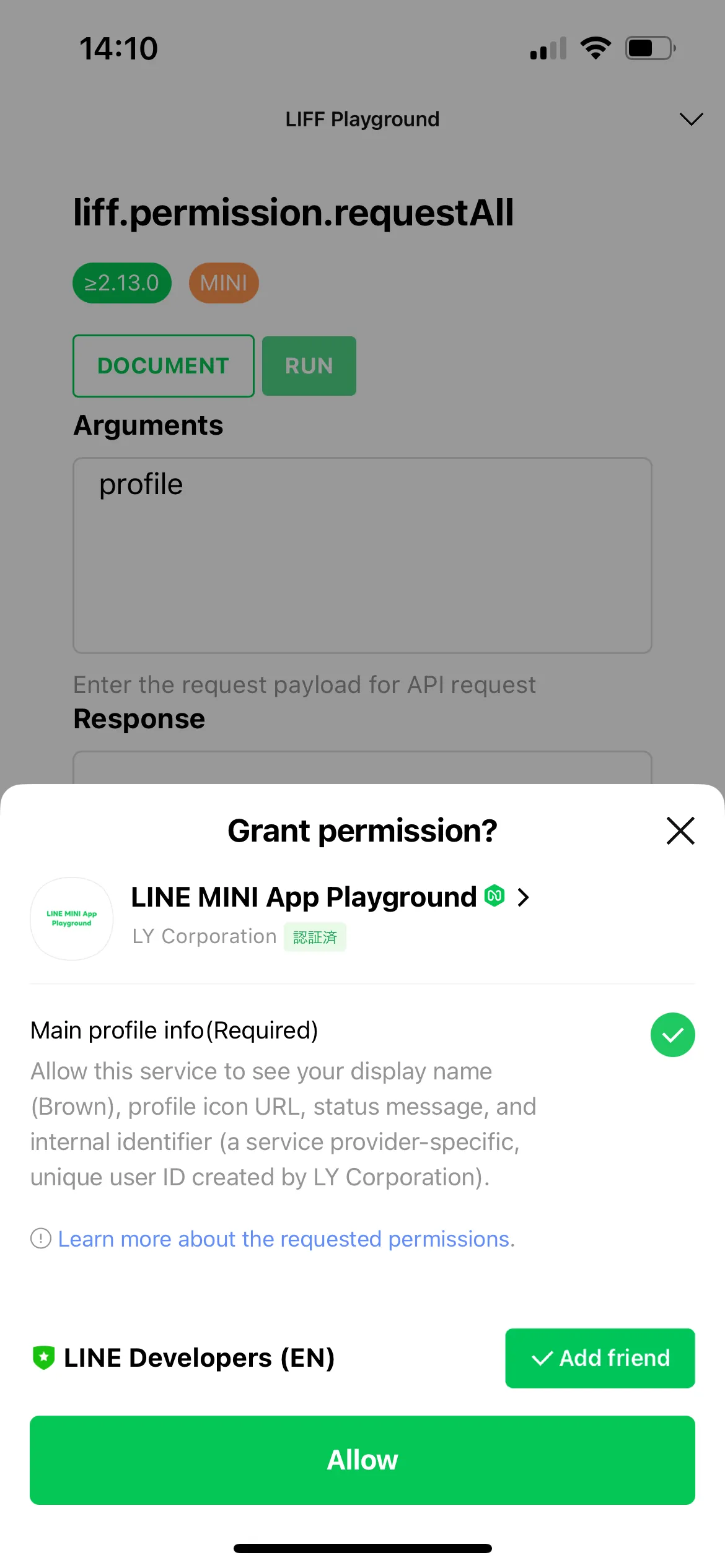
The following methods require permissions other than the openid scope:
| Scope | Method |
|---|---|
email | |
profile | |
chat_message.write |
You can use the liff.permission.query() method and the liff.permission.requestAll() method to display the verification screen at any time.
For more information, see liff.permission.query() and liff.permission.requestAll() in the LIFF API reference.
The "verification screen" is first displayed, not when a user first opens a LINE MINI App, but when permissions for scopes other than the openid scope (the profile scope or the chat_message.write scope etc.) are required.
Therefore, if you've designed your LINE MINI App so that immediately after it's launched, it executes requests that require permissions other than the openid scope, such as the liff.getProfile() method, when users access your LINE MINI App, it would appear as if the channel consent screen were displayed without being skipped. We recommend implementing your LINE MINI App so that requests requiring permissions other than the openid scope are executed only when they are actually needed, whenever possible.
Important points about using the "Channel consent simplification" feature together with the add friend option
In the LINE MINI App, you can use the add friend option to prompt users to add your LINE Official Account from the verification screen or the channel consent screen.
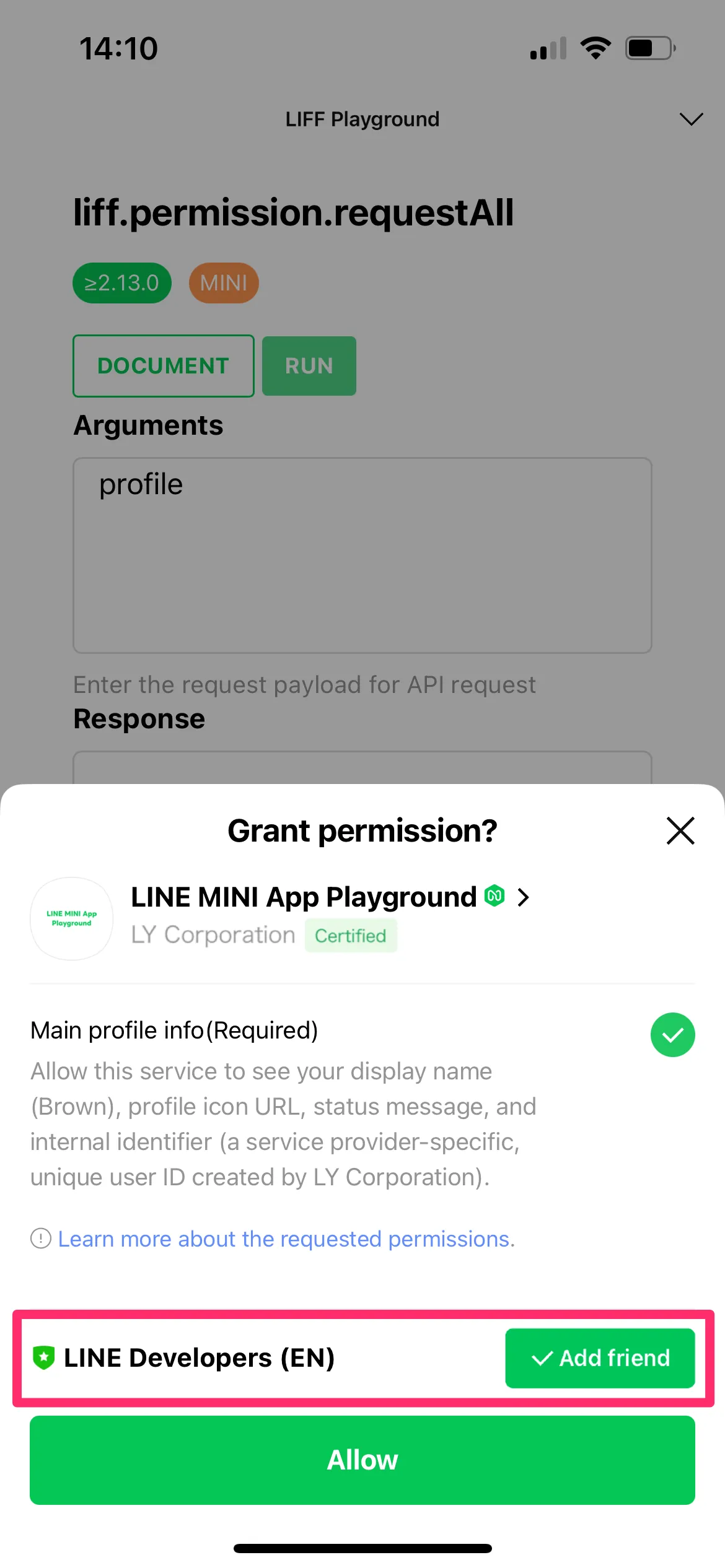
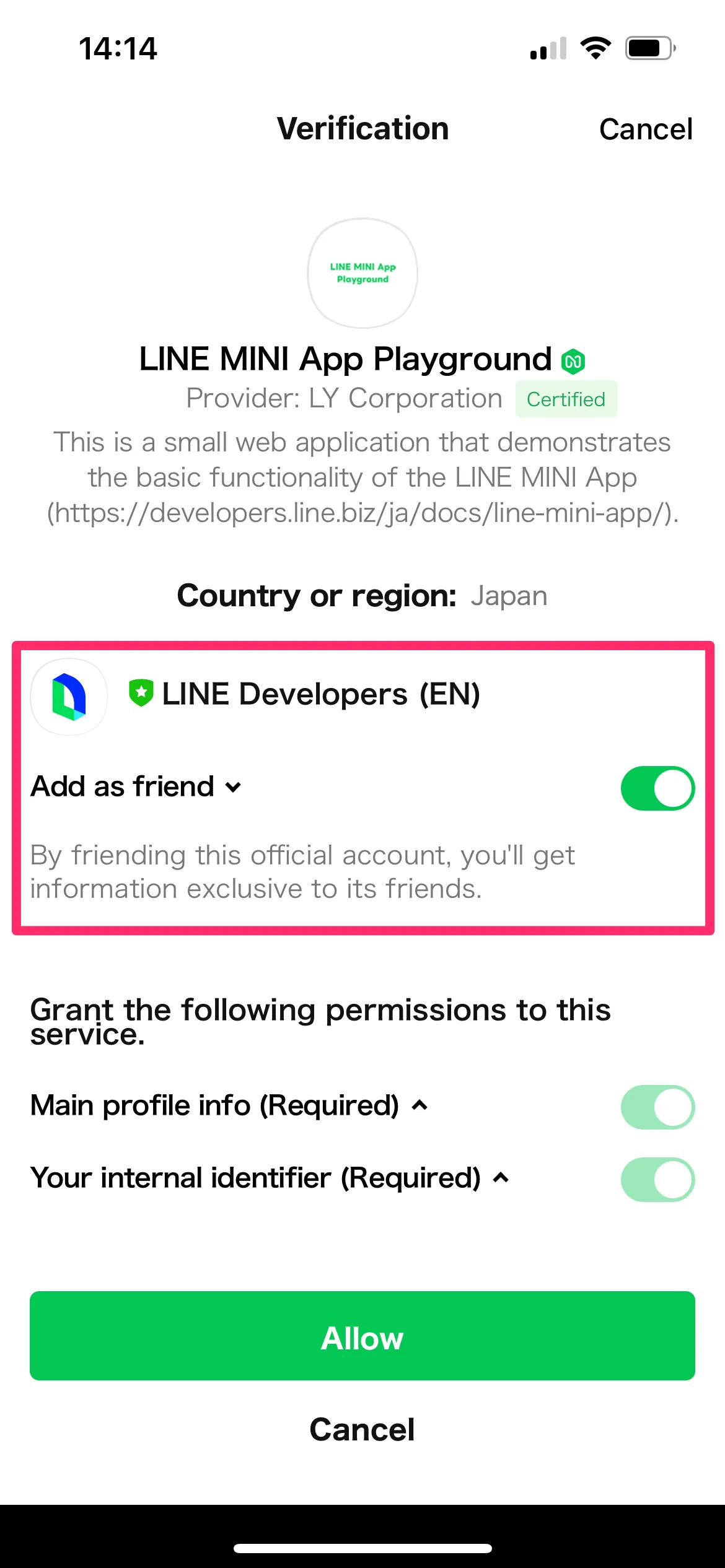
However, if only openid is specified in the Scope section of the Web app settings tab in your LINE MINI App channel, enabling the "Channel consent simplification" feature will prevent the verification screen and the channel consent screen from appearing. As a result, you can't prompt users to add friends using the add friend option.
When using the "Channel consent simplification" feature together with the add friend option, we recommend specifying scopes other than openid in the Scope section of the Web app settings tab in your LINE MINI App channel, and displaying the verification screen. For more information, see Request permissions other than the openid scope on the verification screen.
You can also use the liff.requestFriendship() method to display a subwindow at any time, prompting users to add your LINE Official Account as a friend or unblock it.
Authorization flow in LINE MINI Apps where the "Channel consent simplification" feature is disabled
When users access a LINE MINI App where the "Channel consent simplification" feature is disabled for the first time, the channel consent screen is displayed. On the channel consent screen, a list of permissions requested by the LINE MINI App is shown, and users are asked whether they want to grant those permissions.
When users tap Allow, they can start using the LINE MINI App.